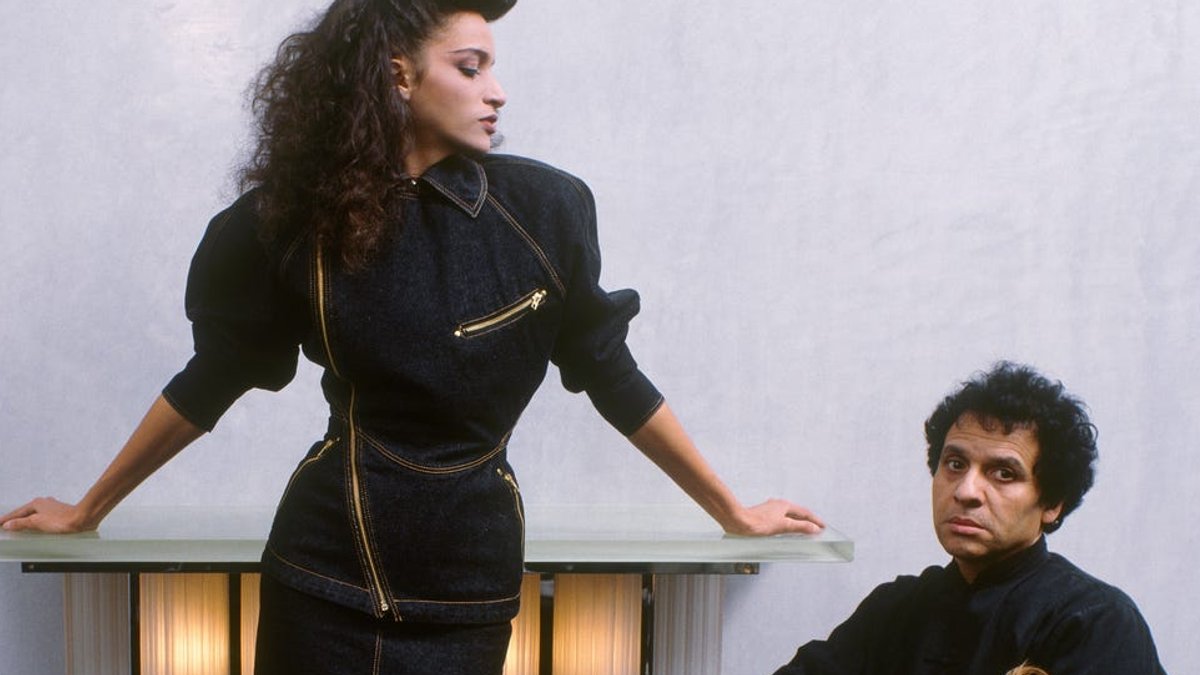
Azzedine Alaïa’s designs, such as the bandage dress and zipper dress, may not seem radical today, but they changed the fashion environment almost 50 years ago. The bandage dress, in particular, is a sign of how the late French-Tunisian designer introduced a new body-conscious silhouette in the 1980s, made possible by technological innovations in materials.
According to Laura Camerlengo, curator in charge of costume and textile arts at the Fine Arts Museums of San Francisco, Alaïa’s designs “were completely shocking” to the public at the time. She has spent four years developing a new exhibition titled “Azzedine Alaïa: Sculpting Fashion,” the first major U.S. retrospective dedicated to the work of the famed couturier, which opened on November 21.
Azzedine Alaïa’s Background and Career
Alaïa was born in 1935 in Tunis and first trained as a sculptor, a background evident in his body of work. He decamped to Paris in 1956 to pursue fashion full-time, working under Guy Laroche for less than two years before taking on his own private clients and launching his own atelier in the late 1970s.
Alaïa’s obsession with construction and material innovation allowed him to celebrate and liberate the female form. He passed away in late 2017 at the age of 82, leaving behind a legacy that continues to influence fashion today.
Camerlengo first encountered Alaïa’s work as an assistant on the “Patrick Kelly Runway of Love” exhibition in 2014. She was intrigued by how many new designers in Paris at the time were being supported by US consumers and retailers. After ascending to her new position in San Francisco, she cold-emailed Olivier Saillard, director of the Azzedine Alaïa Foundation in Paris, and the two began working together on the exhibition.
The Exhibition and Alaïa’s Design Aesthetic
The exhibition focuses on 80 garments from across Alaïa’s celebrated career, divided into archetypes such as the bandage dresses, sculptures and shapes, black and white, silhouettes and suiting, and construction and craftsmanship. Interspersed are designs worn by devotees like Tina Turner, Grace Jones, and Rihanna.
One final gallery highlights Alaïa’s personal collections of the work of designers he most admired, like Christian Dior and Charles James. The exhibition is not chronological, instead exploring how Alaïa’s design aesthetic evolved over the course of his career.
Read Also: Celebrities share effortless airport-to-dinner outfits
When visitors enter the exhibition, they are greeted by Grace Jones, wearing the seminal purple hooded bandage dress from the fashion Oscars in 1985. As they move through the exhibition, they will see a selection of zipper dresses, chiffon gowns, and other works that tie into some of the other themes.
Camerlengo notes that Alaïa’s clothes may not look as radical now, but they were earth-shattering at the time. The popularity of Japanese fashion designers who obscured women’s bodies with voluminous styles and the suiting of the period, which obscured women’s bodies, made Alaïa’s designs a complete 180 from the styles that retailers had gotten used to.
The clear invisible mounts used in the exhibition are actually based on the body of Naomi Campbell, who was one of Alaïa’s muses and protégés. Campbell, along with other women like Tina Turner and Grace Jones, played a significant role in Alaïa’s life and career.
As a collector, Alaïa’s work can sometimes best be understood in dialogue with the work of other designers. For example, his radial tucks and pleating to achieve weightless volume in some of his gowns were inspired by the work of Charles James, the great American fashion designer.
Alaïa’s legacy continues to influence fashion today, and his designs remain iconic symbols of late 20th- and 21st-century fashion. The exhibition aims to showcase the artistry of his work and the importance of handcraftsmanship in an age of increasing technology.
Alaïa’s Tailoring, Muses, and Lasting Influence
Alaïa’s tailoring expertise is highlighted in the exhibition, showcasing suits that fit the body with precision, uplifting and empowering women through cloth. These designs contrast sharply with the looser styles of the 1970s, blending form-fitting cuts with soft feminine touches to create a unique mix of strength and femininity. His ability to work entirely by tailoring and draping, from concept to final product, set him apart as a couturier.
He learned to sew from his sister and was encouraged by a Tunisian midwife, who helped him forge papers to attend the Institute of Fine Arts at 15. Early in his career, he gained support from influential figures like the Rothschilds, Arletty, and Greta Garbo. His muses, including Naomi Campbell, Tina Turner, and Grace Jones, were integral to his work, shaping his designs and legacy.




Leave a Reply