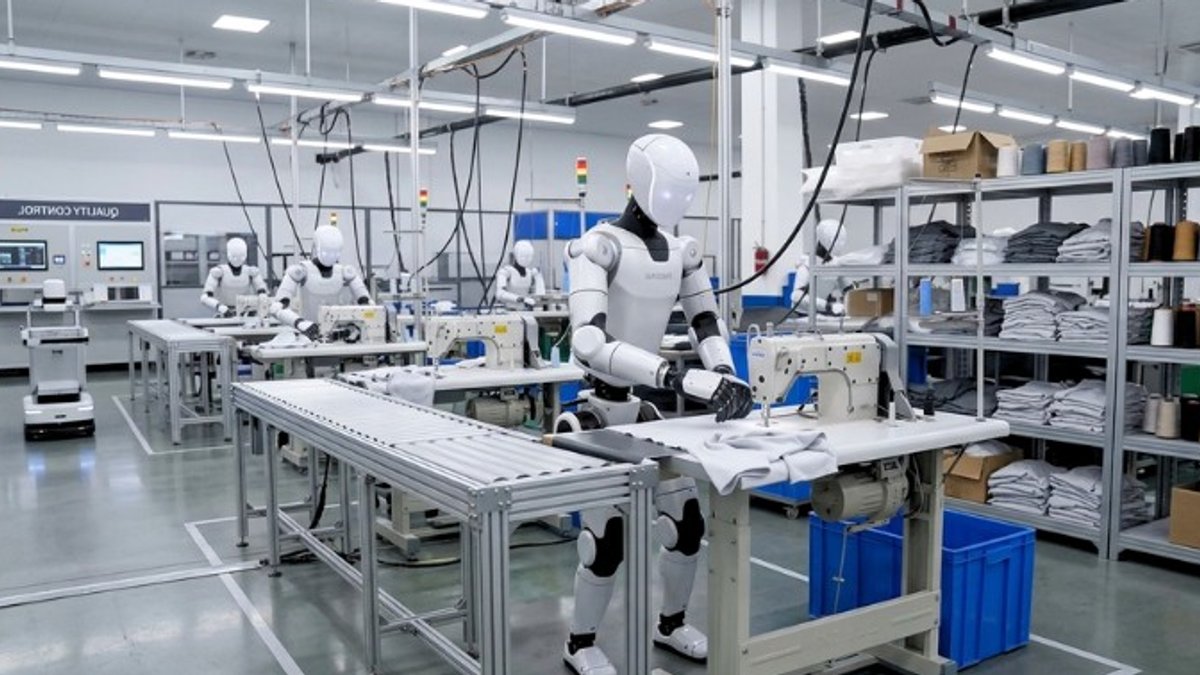
Humanoid robots may be overkill for sewing operations, as the majority of functions in manufacturing workplaces, including apparel manufacturing, require only upper body movements. Sewing, ironing, checking, and folding are examples of tasks that can be performed with limited or stationary lower-body movement. Because most garment assembly stations are designed for workers who stand in place, the need for leg articulation is minimal.
A six-axis cobot, commonly used in industries, has six degrees of freedom (DoF), which is the minimum required to position and orient a tool arbitrarily in three-dimensional space. These machines provide the flexibility to reach around fixtures and to adjust the angle of a sewing needle without requiring a full human-like torso. However, these cobots mimic the upper human body only up to the wrist, lacking palms and fingers.
Sewing Operation Requirements
Sewing operations specifically require dextrous hand movement of fingers and hand movement from the elbow. Pedal start-stop functions are not necessary, as most commercial sewing automats already run without them. The need for precise elbow articulation allows the needle to be guided through layers of fabric while maintaining consistent tension.
Read Also: H&M Australia Fined for Missing Fire Safety Labels on Kids’
A vision-based system can capture images, process them, and direct mechanical actions through robotic hands and tactile end effectors, making it a viable option for sewing operations. The human hand has 27 DoF, and most humanoid robots offer between 11 and 22 DoF, giving them the ability to perform “near-human” manipulation of material.
Cost Considerations
According to a McKinsey report, the cost of a humanoid robot can be broken down into approximately 42% for the upper body, 47% for the lower body, and 11% for the shared platform. An upper body with dextrous hands may be able to perform sewing operations at roughly half of the total expense of a full humanoid system.
Alternative Solutions
Vision systems integration in the sewing process has shown promise in the past, with examples such as Brother’s BAS 311G and Vetron’s Autoseam. Those early attempts were not widely adopted because production volumes were limited and the price points were high. The second reason could be the change of tech from arithmetic logic to AI-based training. Vetron’s autoseam did not use any AI; it is a pure algorithm. It used only X-Y axis manipulation of fabric plies, which worked for stiff, dimensionally stable fabrics.
Read Also: Alice Barbery steps down as Universal Store CEO
The Indian textile and apparel manufacturers are known for their curiosity and willingness to update their knowledge and think ahead. Dr. Prabir Jana analyzed a recent viral video of shop-floor sewing operators in garment factories sporting head-mounted cameras, and his commentary has intensified the discussion about the potential use of humanoid robots in sewing operations.
Sewing is an important value-add operation in apparel manufacturing, contributing nearly 80% of manufacturing value add in terms of time. Simultaneously, sewing operators constitute 80% of the production workforce in a typical apparel manufacturing enterprise, making it a significant pain point for manufacturers.





Leave a Reply