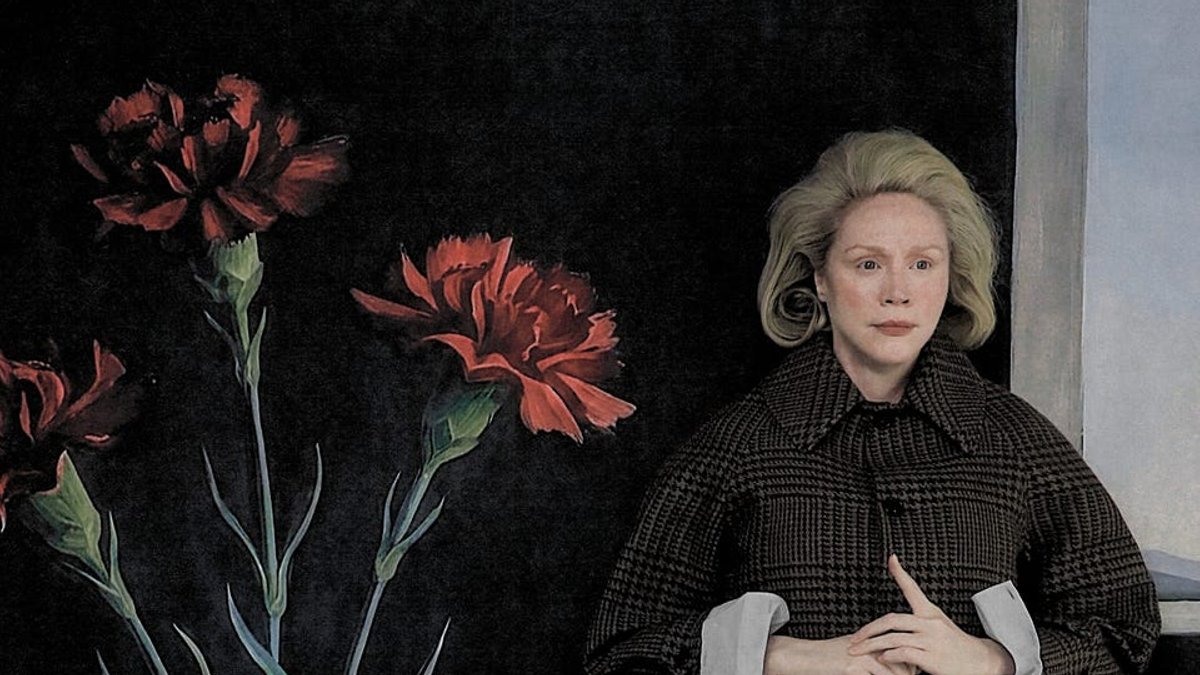
For photographer Szilveszter Makó, the creative impulse dates to a childhood winter in Hungary. As a six-year-old, Makó wanted to dress as a butterfly or ladybug for Farsang, the country’s traditional winter carnival, but his grandparents rejected the idea. His grandmother instead dressed him in a neat white shirt and built a cardboard headpiece shaped like their home, complete with an oval opening for his face. “It is quite funny because I don’t remember feeling deprived of a costume,” Makó recalls, noting he apparently wanted to be a clock.
A visual language of home and scale
Nearly three decades later, Makó has transformed this early memory into a signature motif. The headpiece resurfaced in 2023 when he rebuilt it for Willem Dafoe’s GQ Italia cover. It has since been worn by Cate Blanchett and Gwendoline Christie. Makó draws on surrealism, old-master painting, and cinema to hand-build his sets and props from simple, often recycled materials. “The cardboard itself is not luxurious. The cloth is not luxurious,” he says. “The luxury is the time and the human hand.”
His subjects frequently appear folded into boxes, houses, or structures that play with scale and perspective. The resulting images function as flattened, hypercomposed tableaux rendered in powdery, muted tones. “I take these very grounded, familiar things and interfere with them,” Makó explains. “I reshape, reframe, and reimagine them, changing the scale or placing them somewhere they should not necessarily belong.”
Read Also: Venice Film Festival Best Looks
Bauhaus Ballet turns the frame inside out
With “Bauhaus Ballet,” Makó is reconstructing his childhood house at a human scale. The six-room installation opens during New York Fashion Week from September 8–12 at 29 West 23rd Street. Presented by Capital One in partnership with The Cultivist, the immersive exhibition pairs new portraits of Gwendoline Christie and Adrien Brody with the physical sets where those images were made. “The photograph is no longer the conclusion,” Makó says. “The set existed before the image, and now it exists after it too.”
Visitors will move through recreations of his childhood homes, which reflect a post-communist era where little was wasted and objects were repaired and repurposed. The space also includes a cabinet of curiosities filled with collected ephemera and an interactive set featuring a 45-degree mirror that reflects the scene from above. The experience concludes with billowing linen and the scents of wheat and straw, meant to conjure an Italian summer. “Usually, I compress these references into a single frame,” Makó says. “But here, I am opening the frame and allowing people to walk inside it.”
This September, the Hungarian photographer is essentially turning his practice inside out. The exhibition will be large enough to walk inside, allowing guests to traverse the physical architecture of his imagination.
Read Also: Queen Nazli’s Necklace Stolen at MAK in Vienna
A script for the camera
Gwendoline Christie first entered Makó’s world in 2024 after learning she was already a fan of his work. The connection was immediate, allowing them to work almost wordlessly. “It was a freakish, beautiful gift,” Christie recalls. She likens entering Makó’s world to collaborating with directors like Jane Campion and Tim Burton, whose visions are so fully realized that surrendering to them can become a form of creative freedom.
Christie, who at six foot three has long had her body scrutinized by fashion and Hollywood lenses, says she feels unusually free from that gaze with Makó. “He doesn’t seem to see my physical form as the ultimate form,” she says. “What he sees is something within me.” That sense of trust carries into the styling, where Makó and stylist Lisa Jarvis sourced an archival Fendi dress in Christie’s exact size. “It’s a great act of love when you’re not sample size,” she says. “I truly feel that he loves my body and he loves my body in clothes.”
Makó spends years determining precisely what appears inside his frame. With “Bauhaus Ballet,” he is removing the camera’s static presence, allowing his subjects to move within the space. “I have built the room,” he adds. “They can misbehave inside it.”


Leave a Reply