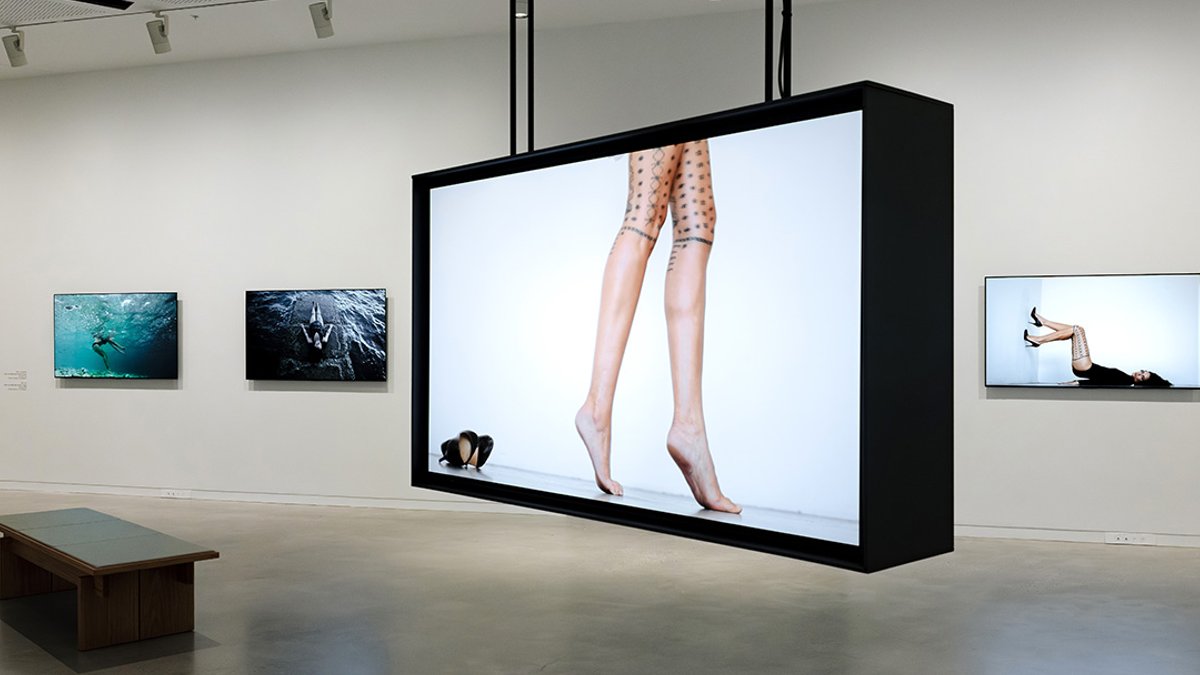
Angela Tiatia’s career retrospective Muse at Newcastle Art Gallery presents a rare chance for mid-career artists to assess their trajectory. The exhibition, spanning two decades of her work, serves as both a professional landmark and an exploration of how she reconciles cultural identity with artistic vision. Tiatia, a Samoan-Australian artist based in Newcastle, frames the show as an opportunity to examine the contradictions shaping her practice—between tradition and innovation, silence and defiance, and individual experience with broader political concerns.
The retrospective traces her output from 2005 to the present, a period she describes as fleeting yet deliberate. “My first work was made in 2005 so I can’t believe it either, but the twenty years have flown by so quickly, but it’s also gone slowly,” she said during installation. This duality mirrors the tensions embedded in her art, where personal history intersects with collective struggles. Her upbringing in Aotearoa within a first-generation Samoan family laid the foundation for these themes.
Read Also: Sydney eases outdoor drinking rules
Her mother, who emigrated from the Pacific Islands, instilled in her both cultural pride and practical expectations. “She saw the world through a very specific lens,” Tiatia recalled. “She was really worried about my financial future, so she encouraged me but also wanted me to get a degree.” After completing a commerce degree, a concession to her mother’s wishes, she later pursued visual arts, aligning her studies with her son’s first day of primary school. Before that, she had spent two decades as a model and actor, beginning at age 17, a path that clashed with her devout Mormon background.
This conflict between autonomy and restraint permeates her work. There is a long history in the Pacific Islands of female bodies being misrepresented by white, colonial, capitalist, patriarchal gaze. Her early resistance took shape through self-directed photography, a tool she wielded to reclaim agency. A defining moment came when she responded to Jeffrey Gaughan’s exhibition at the Art Gallery of New South Wales, directly challenging the male-dominated artistic tradition that had historically objectified Pacific women.
Her 2013 photograph Walking the Wall embodies this defiance. The image features her Malu, a traditional Samoan leg tattoo, displayed with intentional boldness. “I was a model and actor for twenty years before this,” Tiatia said. “I really made Walking the Wall for a Samoan audience. By putting the Malu on display, I got a lot of, how would you say it? Hate, I don’t want to be harsh.
Read Also: New tool tracks fossil fuel project damage
Aspects of my community were livid, but I wanted to make the point that prior to colonization, the Malu was proudly displayed. Because of colonization, vast knowledge systems have been lost. So, I used what I learned through modeling and advertising to craft an impactful image. To hold attention. Draw the audience in with beauty but then punch with the politics. I knew I was being subversive.”
The exhibition also reveals how her artistic approach has adapted over time. Early projects relied on self-taught techniques and limited resources, while later installations incorporate video and large-scale photography to amplify her messages. This evolution reflects a broader trend in Pacific art, where artists increasingly assert narrative control over colonial interpretations.

Leave a Reply